
An estimate that says “upgrade electrical panel” leaves an important question unanswered: will the work replace equipment, create room for additional circuits, increase the home’s electrical service capacity, or do several of those things?
A panel replacement can leave the home’s service capacity unchanged. A service upgrade can involve work beyond the breaker panel. Before choosing a proposal, ask the electrician to describe the starting condition, the finished capacity, and the household plans the work is intended to support.
For a Lakeland or Polk County homeowner, that explanation is more useful than choosing a project by its amperage label alone.
Start with the result you need
Tell the electrician what prompted the call. An inspection report, a proposed EV charger, and a workshop addition are different starting points. Bring the report or equipment information rather than asking for a particular panel size before the home has been assessed.
Then ask for this sentence to be completed in the proposal:
“This project addresses ______. When finished, the home will have ______ service capacity, and the scope includes ______ for the planned equipment or circuits.”
The purpose is to make the promised result understandable. If the contractor cannot confirm part of it yet, have that item marked as awaiting assessment rather than treating it as included.
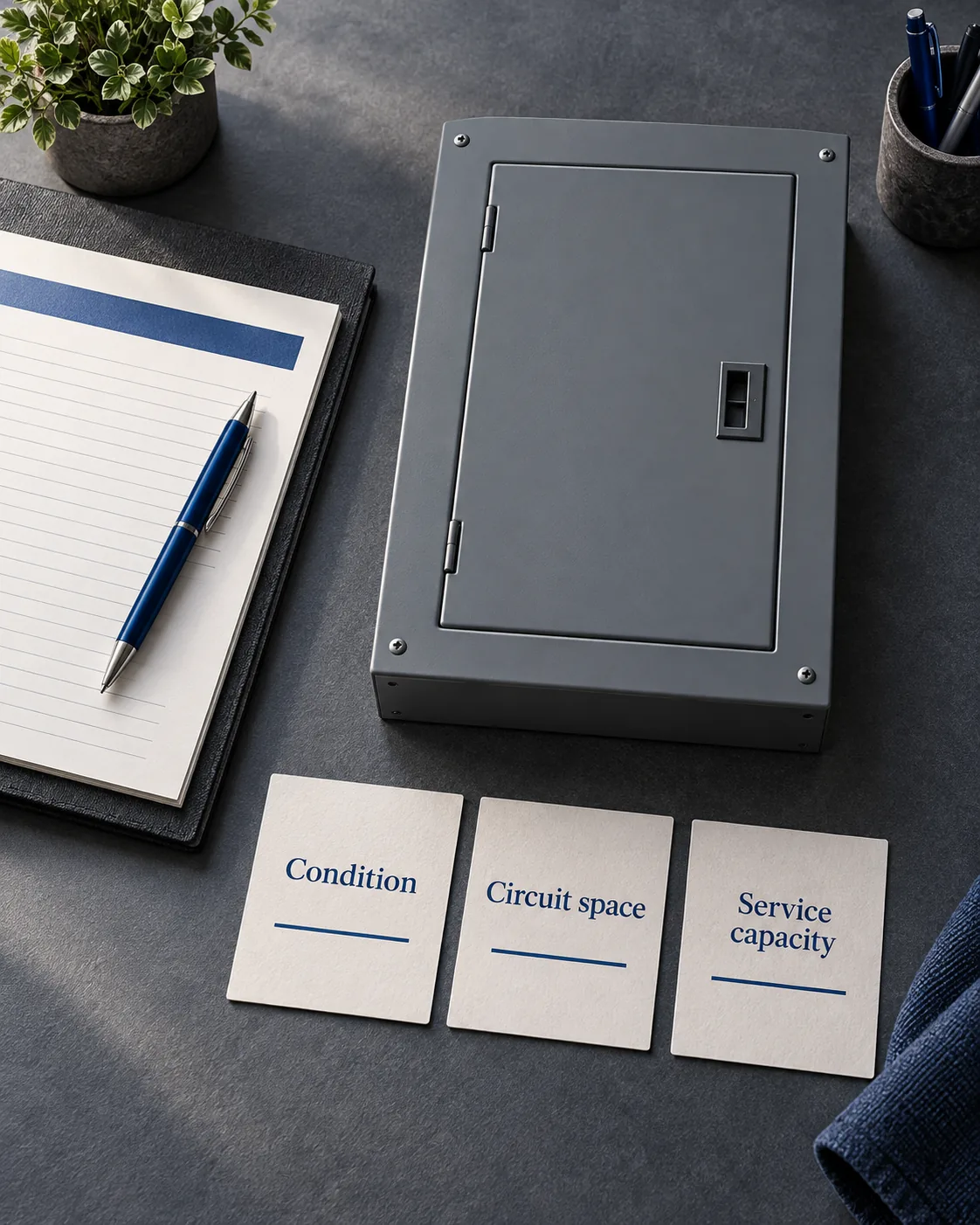
Separate equipment condition, circuit space, and electrical demand
These are related questions, but answering one does not settle the others.
Equipment condition: What specific problem has the electrician found, and what work addresses it? Ask for the finding in plain language. If an inspection report started the conversation, have the contractor explain how the proposed work responds to that report.
Circuit space: Is there an appropriate place to connect the planned circuits? A panel distributes electricity to branch circuits; a subpanel can provide another distribution point supplied from upstream equipment. Adding that distribution point does not itself increase the utility service capacity. ABB’s residential load-center overview explains the distinction between main panels and panels supplied from upstream breakers.
Electrical demand: Can the electrical system support the existing equipment and the proposed additions? Ask the electrician to explain the load assessment and which future loads it includes. Counting unused breaker positions does not answer that question. Lawrence Berkeley National Laboratory’s home-electrification research treats available panel space and amperage as separate constraints.
Use this table to organize the consultation. It is a request for professional findings, not a way to diagnose your own panel.
Use these questions during your consultation.
| Question to resolve | What to ask the electrician to document | What remains unanswered |
|---|---|---|
| Why is equipment replacement recommended? | The condition or limitation being addressed and the equipment included | Whether the service capacity also needs to change |
| How will the new circuits be accommodated? | The proposed circuit arrangement and any additional distribution equipment | Whether the home can support the added electrical demand |
| Why is a service capacity change recommended? | Existing and proposed service capacity, with the assessment supporting the recommendation | Which customer-side and utility-side work is included |
| What will the planned addition actually receive? | The circuits, wiring routes, connection work, and equipment covered by the proposal | Any separate installation or finish work you must arrange |
On a small screen, swipe the table to see all columns.
Ask for a before-and-after scope
Consider a hypothetical homeowner who needs a replacement panel and also intends to add EV charging. One proposal covers the panel replacement at the existing service capacity. Another covers a capacity increase but leaves the charger circuit for a later estimate.
Neither description, by itself, promises a working charging installation. The useful comparison is whether each proposal reaches the same agreed endpoint.
Ask the contractor to identify three things in writing:
- What stays: Existing equipment or wiring the proposal assumes can remain, including anything still awaiting inspection.
- What changes: The panel, service equipment, circuits, and related work actually included.
- What is deferred: Planned additions, separate contractor work, or decisions that need another assessment.
A proposal can then explain, for example, that it replaces the panel while retaining the assessed service capacity, or that it increases service capacity and includes a specified new circuit. Those are illustrative scope descriptions, not recommendations for a particular home.
Keep equipment ratings and the completed service capacity explicit. A new panel model on a parts list is not a complete description of what the finished electrical system will support.
Account for the utility and the interruption to power
Confirm the electric utility serving your address and the permitting authority for the property. A Lakeland mailing address should not be used as a substitute for that check.
For customers served by Lakeland Electric, its published Standard Electric Service Requirements require advance notification before adding a significant load. They also connect service alterations to the necessary inspection approvals. Sections 2.3 and 2.8 explain these responsibilities.
Ask who will coordinate the required steps, what must happen before reconnection, and which charges are included or still awaiting confirmation. Request an expected power-interruption window and an explanation of what could extend it. Avoid planning an essential household activity around an assumed same-day restoration.
If power loss will affect medical equipment, refrigeration, remote work, or another household priority, tell the contractor before scheduling. Agree on arrangements appropriate to your situation; the homeowner should not improvise temporary electrical connections.
Include future plans without assuming the largest service is necessary
Give the electrician a short list of additions you are seriously considering, with their likely timing. Separate a confirmed vehicle purchase from an undecided workshop or future pool. That helps the contractor explain what the current design includes and what would need reassessment later.
Equipment selection and professionally designed load management can sometimes change the capacity needed for a project. An ENERGY STAR-hosted technical presentation discusses these alternatives. Suitability depends on the home, equipment, and applicable requirements; this is a question for the designer, not a reason to dismiss a documented service limitation.
If an alternative is offered, ask what operating tradeoff it introduces, what equipment it requires, and what the total installed scope covers. Compare those answers with the proposed service upgrade before deciding.
Bring a clear brief to the assessment
Prepare your property address, utility name, any relevant inspection report, and the models or specifications of equipment you plan to add. Include existing electrical plans or previous project records if you have them. Leave panel-cover removal and equipment inspection to the electrician.
Ask for a written explanation of the recommended work and its limits. You should be able to identify the problem being solved, the capacity the home will have afterward, and whether the planned new equipment is included in the finished job.
For help defining that scope, request a panel and service assessment from Barnes Electric. Bring your current concern and planned additions so the conversation starts with what your home needs to support.