
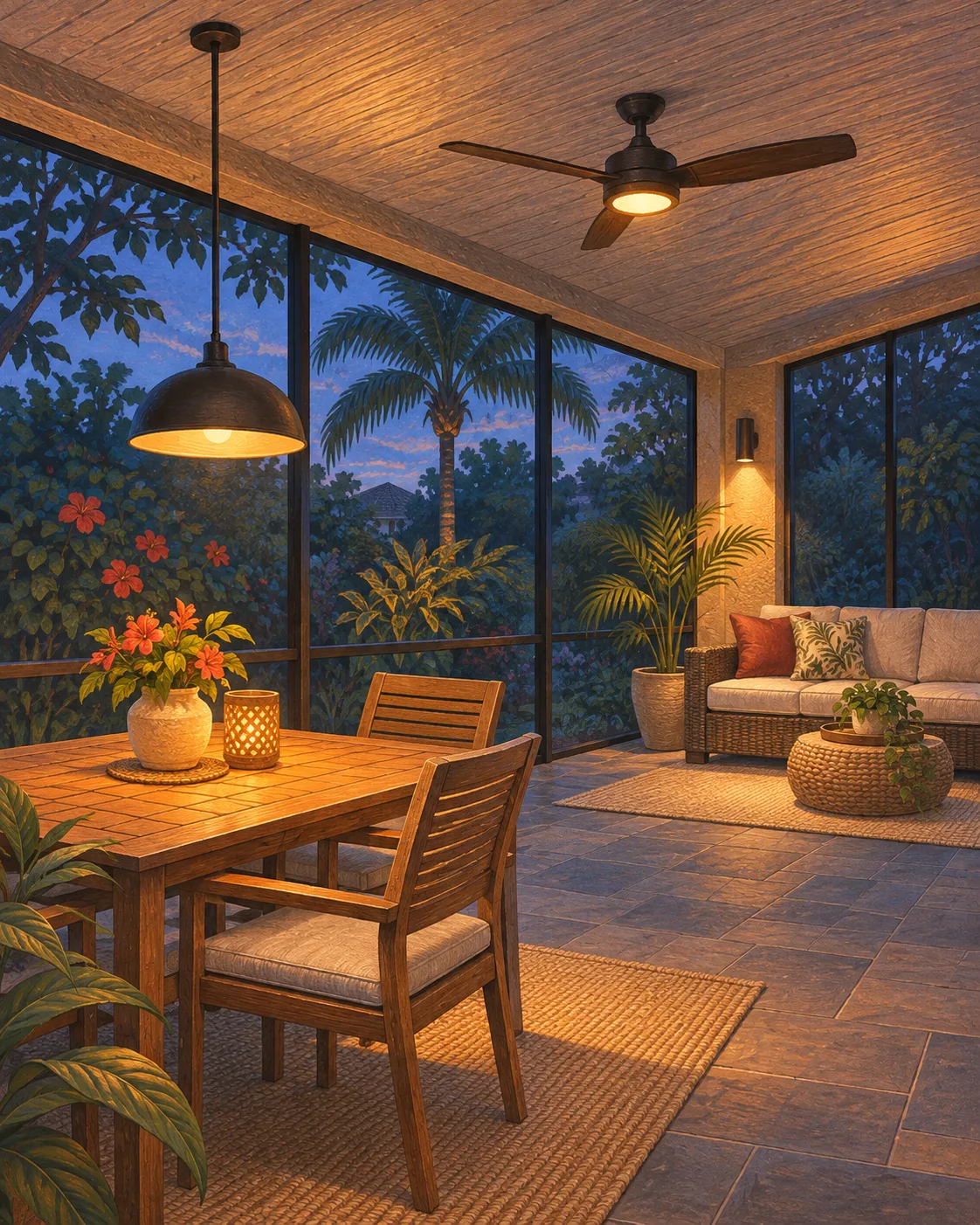
A lanai lighting plan should explain how the space will work after dark. You may want enough light for dinner at the table, a quieter setting for conversation, and brighter light when it is time to clear everything away. A drawing that shows only fixture locations leaves those differences unresolved.
For a covered lanai in Lakeland or Polk County, start with the activities and furniture layout. Then ask the electrician or lighting designer to connect each activity to the fixtures and controls that will serve it. Agree on an evening walkthrough so you can check the finished result from the places where you will actually sit and walk.
Give the designer a plan of the occupied space
Mark the dining table, chairs, sofa, television if planned, doors, and the route between the house and yard. Include ceiling fans and any planned changes to the ceiling or screen enclosure. A photo can help explain the existing space, but measurements and the actual site assessment belong in the design process.
Describe what bothers you about the current lighting. “The light is in my eyes when I sit on the sofa” is more useful than “the patio needs better lights.” So is “I cannot read at the table without turning on every light outside.”
For an existing lanai, explain which finishes you want to retain. Ask the installer to show any proposed visible conduit, boxes, access points, or finish repairs before you approve the work. A fixture photograph does not show how it will be installed in your ceiling.
Describe the settings you want to use
Use this table as a starting brief. These are illustrative preferences, not prescribed light levels or electrical circuit designs.
| Activity | What you want to be able to do | Control question to resolve |
|---|---|---|
| Dinner or a board game | See the tabletop and people seated around it comfortably | Can the table lighting work without bringing the whole lanai to its brightest setting? |
| Conversation or television | Keep the seating area comfortable while retaining useful light for moving around | Which lights can be reduced or switched off independently? |
| Cleanup and closing up | See the surfaces being cleared and the route back inside | Can someone select this setting and turn it off from a convenient location? |
Scroll sideways to read all three columns.
The answers may involve ordinary switches and dimmers, a programmed scene, or a combination. Ask the installer to explain the proposed operation without assuming that every project needs an app.
Consider a hypothetical lanai with a dining table at one end and a sofa at the other. One dimmer controlling every light might leave the homeowner choosing between a comfortable sofa area and a usable table. The design conversation should establish whether those areas need independent control before the wiring scope is accepted.
Discuss direction, brightness, and color separately
A light can be bright enough for its task but uncomfortable when viewed directly. Ask how the proposed fixture directs light, and whether the source will be visible from the dining chairs or sofa.
DarkSky International and the Illuminating Engineering Society recommend directing outdoor light where it is needed, avoiding unnecessary brightness, and using controls to limit operation to useful times. Apply those principles to the lanai and the view beyond it. Five Principles for Responsible Outdoor Lighting.
Keep brightness and color appearance distinct when reviewing products. Lumens describe light output; Kelvin describes whether the light appears warmer or cooler. A warmer color does not, by itself, tell you how much light a fixture produces. Department of Energy consumer lighting guide.
Ask to compare the proposed color appearance with the lights visible through adjacent doors or windows. If samples or a demonstration are available, use them to explain your preference. Leave fixture quantity, spacing, and beam selection to the designer working with the actual layout.
Confirm outdoor suitability and dimming performance before buying
A roof over the lanai does not settle the suitability of every fixture location. Tell the installer where rain blows in or water reaches the space, and have them verify the selected products for their actual exposure and mounting conditions.
UL’s luminaire marking guide distinguishes damp locations, which can include condensation and partial protection, from wet locations where water may drip, splash, or flow against equipment. The guide explains that wet locations require luminaires marked for wet use. The installer should confirm the current product documentation and applicable requirements for your installation. UL Luminaire Marking and Application Guide, environmental location markings.
Have the lighting and control products checked together, too. Lutron’s support guidance notes that some LEDs are not dimmable and that incompatibility can cause flickering or buzzing. “LED” on a fixture and “dimmer” on a switch are not enough to establish that the combination will perform as intended. Lutron LED dimming guidance.
Ask the installer to demonstrate the agreed dimming range and normal on/off operation at handover. This is a request for a working result, not an instruction to adjust wiring or open electrical equipment yourself. If the project extends to a pool or spa area, have that scope assessed separately rather than extending a covered-patio plan by assumption.
Walk through the finished lighting after dark
Arrange this check with the installer when agreeing on the scope. Use the intended furniture positions and operate the lights normally.
- At the table: Check the activity you planned, such as reading a game card. Look toward the other seats as well as down at the table.
- At the sofa: Try the relaxed setting. Note any distracting bright source or reflection on a television screen.
- At the doorway: Walk the normal route between the house and lanai. Check whether the controls are understandable and conveniently placed.
- From your own yard and adjoining room: Look back at the lanai. Note unwanted light reaching windows or beyond the intended area, and ask the installer about appropriate adjustments.
Record the setting and viewing position when something needs attention. “The fixture nearest the screen is uncomfortable from the end dining chair” gives the installer a specific issue to review. Ask which adjustments are included and which would change the agreed scope.
Barnes Electric’s custom lighting service includes fixture planning, dimming, and exterior architectural lighting for lanais. To discuss your project, call 863-213-5099 or request a design consultation through that page. Bring the furniture layout and the activity table so the conversation starts with how you want to use the space.